I’ll Climb That Mountain When I’m Ready
What Alex Honnold’s mindset reveals about pressure, timing, and the courage to say “not today” until you are truly ready.

Last month there was a live event on Netflix that I had zero interest in watching.
My partner, Erin, told me about it a few days beforehand. She said they were going to be televising – live– someone climbing a skyscraper in Asia somewhere. The catch was… well, there was no catch. This climber would be working with no ropes, no harnesses, no net. In other words, if he fell... it was the end.
Netflix promoted the event hard:
Be sure to be tuned in to Netflix on Friday, January 24, 2026 at 8 p.m. ET for a live spectacle like you’ve never seen before. No ropes. No fear. Free solo legend Alex Honnold risks it all in a high-stakes live ascent of one of the world’s tallest skyscrapers in Taipei, Taiwan.
My reaction was still:
I'll pass, thank you. I'll stick to binge-watching 11/22/63.
I've seen numerous climbing documentaries before. I am fascinated by Mount Everest and how it has become a touristy thing now.
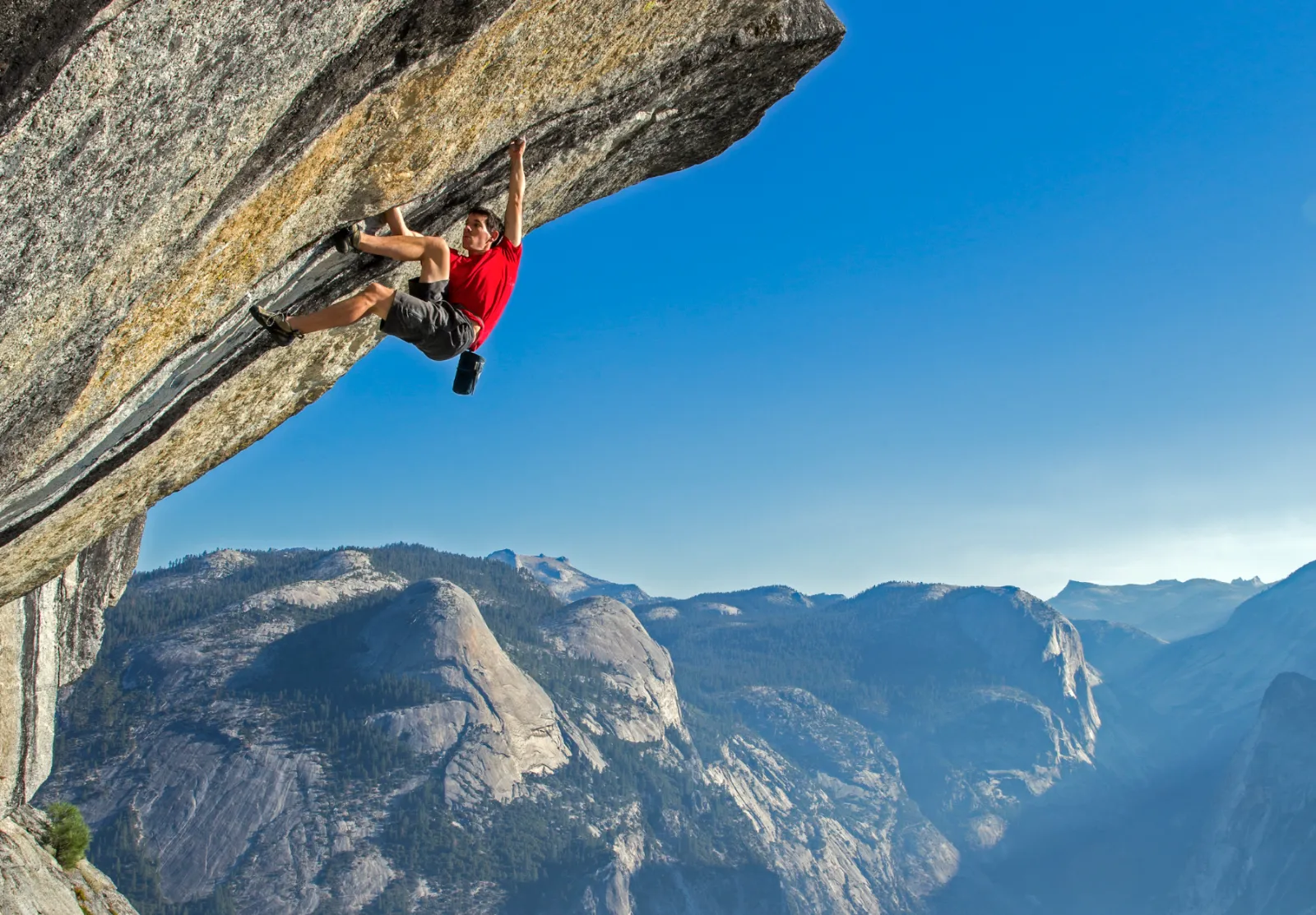
I knew the basic concept of what Honnold was attempting. This wasn’t ordinary rock climbing. This was free soloing, which involved climbing with no rope or safety equipment. It was just your own body, your mind, and a bag full of chalk to keep your hands dry.
After the fact, I realized I had seen this climber in a documentary, Free Solo, a few years ago. And I was mildly surprised—but probably should not have been—to learn that the man making this climb was that same guy, Alex Honnold.
Then again, how many people on earth are crazy enough to do this sort of thing at that level?
But that, alone, was not what got me thinking about writing this article. Quite frankly, I just dismissed stunts like this as suicidal and completely irrational – something ordinary people like me will never comprehend.
When George Mallory was asked why he wanted to climb Everest, he gave the famous line: “Because it’s there.” That is the mentality of climbers like Honnold.
You and I might drive by a tall building or a majestic mountain, turn, and say to our partners, "Damn, that's big. Beautiful, but big." People like Honnold look at the same thing and say, "I want to climb that!"
The thought about writing something about the climb never even crossed my mind. I couldn't relate to that sort of mentality.
Then Erin told me said something I could relate to. She told me that Netflix was nervous. Not because they were concerned about Honnold falling to his death. Heck, that would be great for ratings! Don't tell me there wasn't an exec or two that was secretly thinking that.
What did get me thinking about writing this article was Erin telling me that she had heard Netflix wasn't concerned about Honnold doing the climb – they were worried he wouldn't do it at the time they wanted him to do it.
Think about it from the Netflix side. They had spent money promoting the event. They had built a whole marketing campaign around it. Cameras, crews, equipment, travel, sponsorships, ads—this was a major live production to be broadcast at a specific time.
The storyboard had Honnold kissing his wife, Sanni, and his two young daughters (ages four and two), and beginning his climb at 9 a.m. Taiwan time.
Netflix was worried, however, because Honnold had told them that he will climb when he is ready. If he woke up at 7 a.m. and he "wasn't feeling it that day," he wasn't going to climb that day.
Anyone who has watched enough movies can see the scene play out in their head:
Honnold sitting alone at a long table in a conference room, leaning back in his chair with his hands folded behind his head, while an exec berates him, slamming his hand on the table as he speaks:
We're paying you a ton of money to do this, and you are going to do it when we tell you to do it! Do you understand me?!?
Honnold did understand, and he didn't care.
Which is what I admired so much about the statement that Erin claims she heard somewhere that he had said it. I searched everywhere online and watched two very long podcasts – Jay Shetty Podcast and The Diary of a CEO. If you haven't heard of those two podcasts, I highly recommend them, along with Anderson Cooper's, All There Is.
I'll give Erin the benefit of the doubt, although she has come to regret ever telling me Honnold said that because I have been saying some variation of it to Erin ever since.:
I'll do the dishes when I am ready.
I'll go to Target with you, but I can't tell you what time I'll be ready to go.
I'll get out of bed when I feel like it.
If she pushes back, I tell her, “Hey, I’m just being like that climber guy. I’ll climb that skyscraper when I’m ready.”
At this point, she mostly sighs, rolls her eyes, and walks away, probably regretting the day she ever mentioned the story.
Although I couldn't find Erin's exact quote anywhere online pertaining to Netflix execs being worried Honnold might "chicken out," I did hear him mentioning climbing El Capitan in a few podcasts.
El Capitan is rock climbing’s Moby-Dick: white, massive, humpbacked, and unforgiving, the kind of beast that taunts climbers every day with its presence. It was the basis for the Free Solo documentary.
The first time Honnold saw El Capitan, he knew he wanted to climb the beast. And he was going to climb it.
But he didn't give himself a deadline. He trained – both physically and mentally. And even then, he'd drive up to the mountain, numerous times, prepared to climb it and wound up saying, "Nah, not today."
He didn't view himself as a failure for backing out on those occasions. The mountain wasn't going anywhere. It would always be there.
By his own account, there were many times – over the span of a decade – he got close, many times he thought about it, many times he was in position to do it, and many times the answer was still some version of: not today.
It's a near-impossible task to climb any mountain when a person is 100% "on their game." Honnold understands this, and that is why he is still alive at age 40 when a lot of his rock climbing friends are dead.
That is what people often get wrong about courage. They think courage means doing something when you don't want to. Sometimes it does. But sometimes courage means refusing to act just because other people want you to.
Most of us are not staring up a mountain or skyscraper. Most of us are staring at much smaller things: chores, obligations, decisions, finances, family expectations, peer pressure. But the psychology can be the same. There is always someone, somewhere, wanting things done on their timetable.
Do it now.
Why haven’t you done it yet?
What are you waiting for?
But readiness does not always arrive on command.
And the same was true with Taipei 101. He didn't care how much the network was invested in the event. This was his life. Being physically ready is the easy part. Getting in shape, physically, is predictable. You work out every day, you will get stronger and increase your endurance. The mental part, though – that is the unpredictable part.
You can prepare mentally every day for years, but you never know how you'll feel when you wake up that designated day. You might even wake up feeling fine, but you won't know how you feel when you get up close to the mountain and look up.
Maybe it's the way the sun is hitting off a certain reflective section of rock. Maybe it's a flock of crows that are circling overhead. Maybe it is the sound of a construction site off in the distance. Maybe it is just a feeling in your gut.
As it turned out, the live event did get postponed one day, but due to rainy weather.
The next day, however, if Honnold didn't feel ready, he wasn't going to be pressured – by people or money – into climbing. To hell with "The show must go on." No, it doesn't.
We hear endless clichés about acting quickly. Don’t wait until tomorrow. Do it now. Push through. Stop making excuses. Some of that is useful. A lot of it is not. Sometimes those sayings motivate people. Sometimes they just shame people into acting before they are ready.
Sometimes waiting can be a sign of avoidance, or weakness. But sometimes waiting is prudent. Sometimes it is self-awareness. Sometimes it is the courage and strength not to let outside pressure override your "gut feelings."
Don't get me wrong – we shouldn't put off everything forever. We shouldn't get in the habit – like I have, mockingly, been doing this week with Erin – of saying “I’m not ready” as a blanket excuse for everything you don't want to do.
But being prepared matters. The right timing matters. Mental preparedness matters. And a person will do something far better if they do it when they are ready, rather than if they do something when they don't feel like doing it – at that precise moment.
So the lesson is: Don't sweat deadlines.
Unless it’s a court date. Show up for that.
But for much of the other stuff, I think we would all be better off if we stopped listening to other people tell us when to do things.
Sometimes the smartest – and most satisfying – thing to say is:
I don’t feel like climbing that skyscraper today.