
Shocking Ancestral Discoveries: Lucille Ball, Elizabeth Tilley, and the Mayflower
A deep dive into ancestry uncovers a Mayflower connection—tracing Elizabeth Tilley’s survival and how one life shaped millions, including someone close to home.

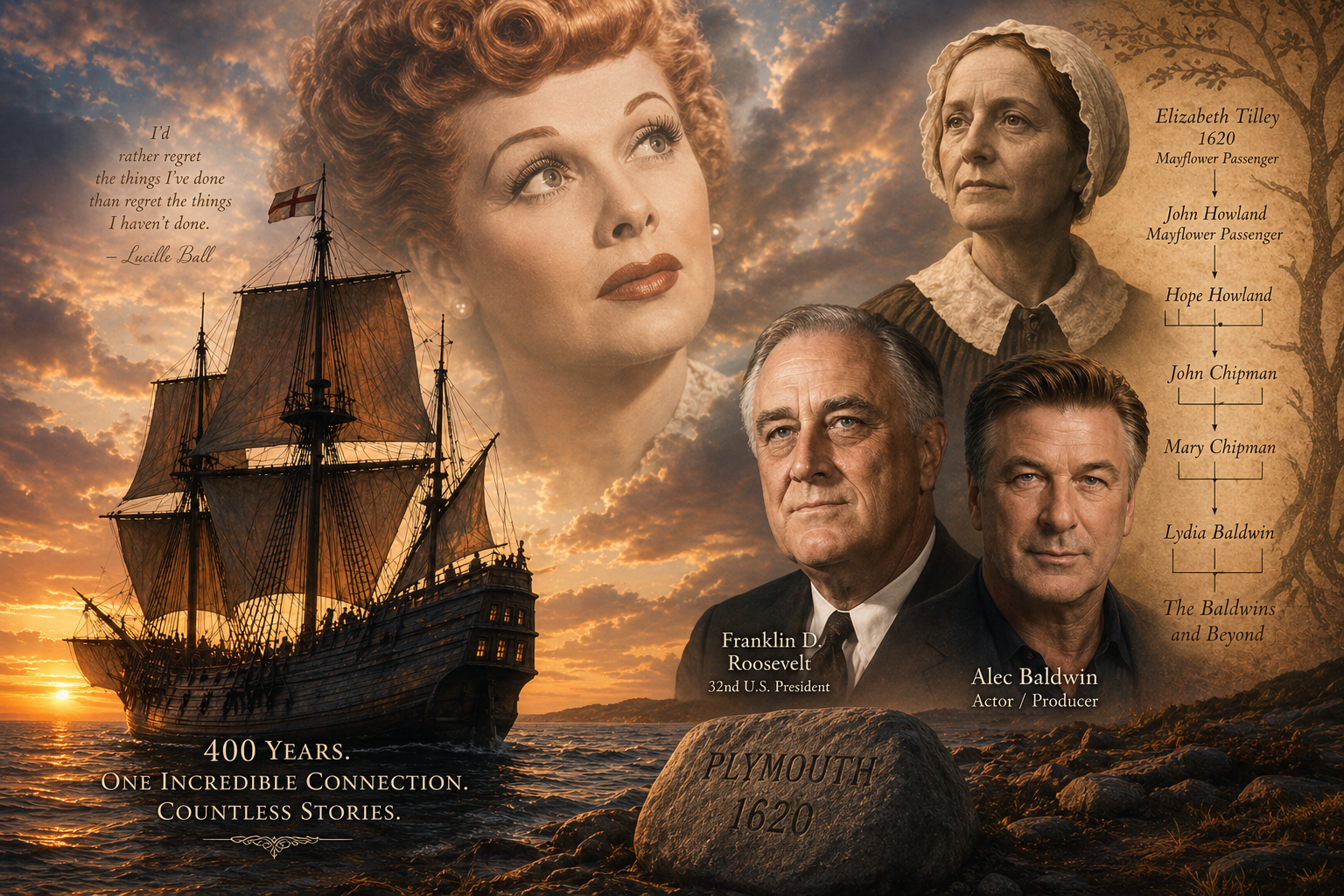
My partner, Erin, has taken to nicknaming me “Rabbit.” Not all the time—that would be weird. But whenever she sees me get an idea in my head, she knows exactly what’s coming next.
I’m not afraid to admit it—I have an addictive personality.
Thankfully, this isn’t the kind of addiction that ruins lives. Erin might disagree, especially when I'm going down these “rabbit holes” at 3:00 in the morning.
I’m addicted to knowledge.
Over the course of this GotMeThinking journey, I’ve obsessed over AI-generated music, chess, poker, tornadoes, JFK, and basketball. Each one takes over for a while before something new comes along.
Lately, that something has been Ancestry.com.
The Search Begins
I’ve dabbled in Ancestry before. I’ve always been curious about where I come from.
My parents immigrated to the United States from Portugal in 1967. I knew my grandfather had come over earlier, around 1913, settling in New Bedford, Massachusetts. For a time, it looked like he was doing well—until the Great Depression hit in 1929. From there, the trail fades. He returned to Portugal, where he and my grandmother lived out the rest of their lives.
On my mother’s side, I hit a wall even faster. I couldn’t trace anything beyond my grandparents.
In both cases, the trail got cold around the late 1800s.
The Rabbit Hole Opens
Erin’s maternal side—Italian—was fun. I was able to go back to the early 1600s. But I didn't uncover anything notable or jaw-dropping.
Then, almost as an afterthought, I clicked into her father’s Irish roots.
That’s when everything changed.
The rabbit hole didn’t just open—it begged me, "Come on down!"
My first great discovery happened about a month ago. I discovered Erin's father is a descendant of a soldier who fought in the American Revolution. Erin's father is a Son of the Revolution. Which makes Erin a Daughter of the Revolution.
I couldn’t wait to share the news.
Her family’s reaction? Underwhelming would be generous. I may have even noticed a yawn.
After I was done speaking, her brother held up a colorful dish he bought at a thrift store, and you would have thought he was unveiling the Mona Lisa.
When History Gets Personal
One of the great things about Ancestry is that it keeps feeding you clues—little hints about where to look next.
Sometimes, it'll even show a famous person that may be related to you. One day, it teased me by telling me Erin is related to Lucille Ball—her seventh cousin, three times removed. I just had to find the connection, which I, eventually, did (probably at 3 in the morning).
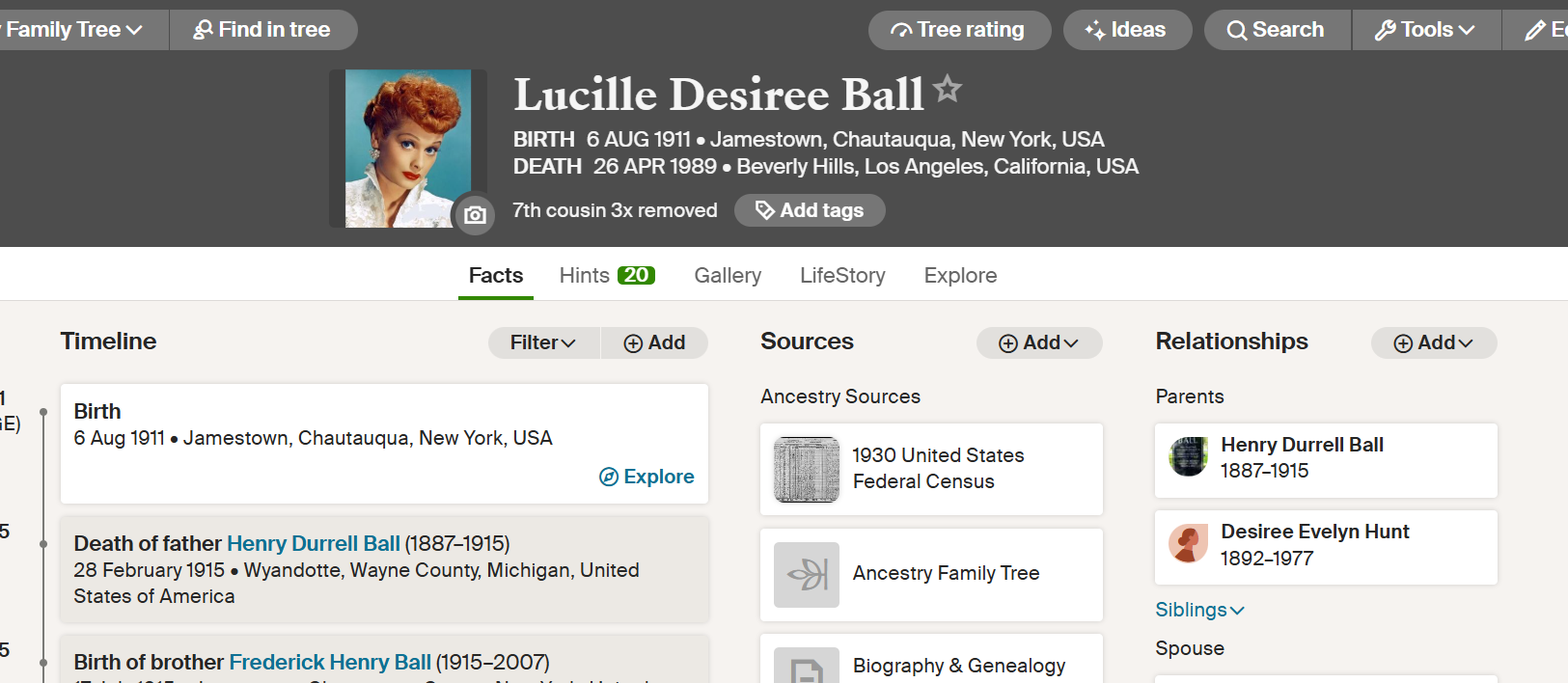
Besides being wicked cool, the irony is that Erin's mother's favorite show growing up was "I Love Lucy." Surely, she'd be excited to find out she married someone who is related to the red-headed icon of comedy.
The announcement got a slightly better reaction. Still nowhere near my level of excitement. Erin might argue no one ever could.
As I kept digging, I started to notice a pattern: Erin’s family tree was full of Revolutionary War veterans—some of them prominent figures.
At a certain point, it almost became routine.
“Oh look… another one.”
And then Ancestry dropped a huge bombshell that got me real excited.
The Mayflower Connection
The name it presented to me was Elizabeth Tilley.
You may be having the same reaction I had when I first saw the name—"Who?"
I then learned Elizabeth Tilley was on the Mayflower!
At the age of 13, she survived the perilous trip across the Atlantic with her father, mother, uncle, and aunt.
I was surprised to learn there were only 102 passengers on the Mayflower. I don't know why—I thought there were much more. Maybe I pictured the Mayflower like the Titanic.
Unfortunately, the Pilgrims arrived in Plymouth at the start of the winter of 1620. They were ill-equipped for the harsh winter to come. Heck, they were expecting to land in the Bahamas—or, more realistically, the North Carolina/Virginia area.
That first winter in Plymouth was brutal. Disease spread quickly. Food was scarce. Exposure to the elements, hunger, and illness claimed lives at a staggering rate.
By the end of that winter, more than half of the passengers were dead.
Elizabeth’s parents were among them. So were her uncle and aunt. She was left with nobody. An orphan.
Survival—and the Butterfly Effect
Elizabeth was taken in by the Carver family.
Another passenger, John Howland, came over on the Mayflower serving as an indentured servant for the Carver family. When the Carvers died shortly thereafter, Howland inherited their estate—including Elizabeth, as it turned out.
They married and had ten kids. All ten lived to adulthood—no small accomplishment for that time period.
Those children had children. And those children had children.
Today, historians estimate that millions of people descend from John Howland and Elizabeth Tilley.
In a sense, she is a Founding Mother of America.
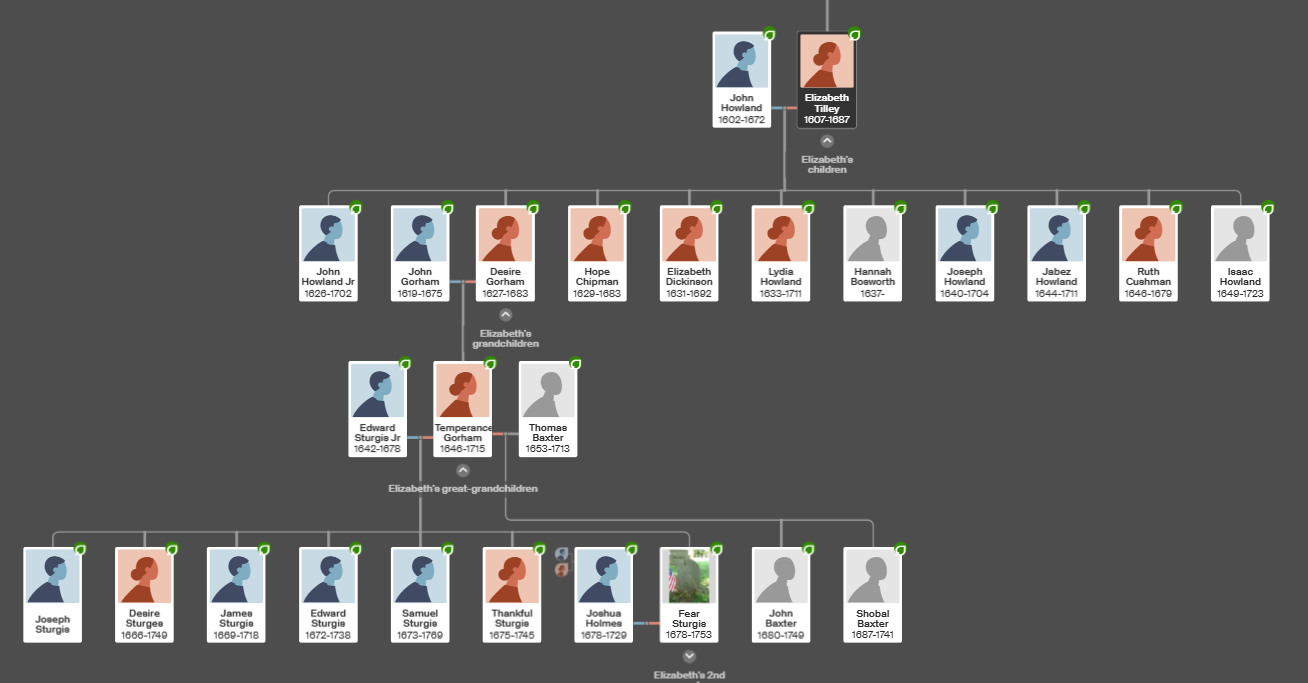
That is the "butterfly effect" in its purest form. Had Elizabeth not survived that first winter of 1620-21, millions of lives, today, would have been altered.
Erin wouldn't be here.
Walking Through History
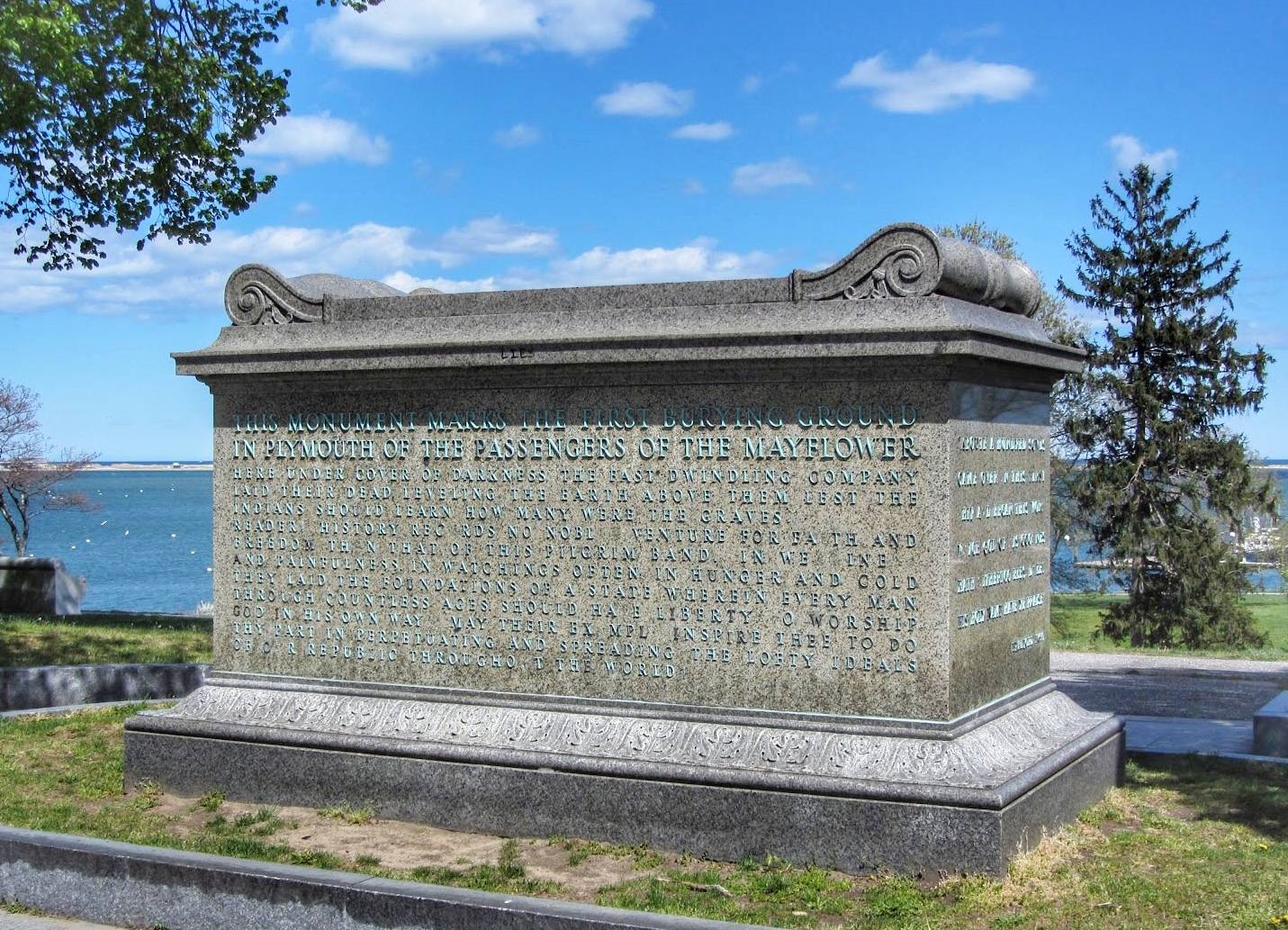
Overlooking Plymouth Rock is a massive stone sarcophagus containing the remains of several unidentified Pilgrims. It rests on the same burial ground where the victims of that first harsh winter were once buried in secrecy. At some point in the years that followed, the town of Plymouth collected those remains and brought them together in this single monument. Etched into a plaque on its side are the names of those who perished—including the parents, aunt, and uncle of Elizabeth Tilley.
Just up the street, Old Burial Hill rises above the harbor. One of the oldest cemeteries in colonial America, it became the final resting place for generations of Plymouth’s earliest settlers. Many of the original Pilgrims were buried in unmarked graves, hidden to protect the vulnerable colonists from unknown dangers during those early days.
Walking among the weathered, barely readable stones—knowing that Erin has a direct connection to this tiny group of settlers—it’s hard not to feel like just a speck of dust in the grand scheme of things. I was overcome with how insignificant we are—yet, how significant we can become.
In the context of everything happening in the modern world, I couldn’t help but reflect on the hardships this small group endured—struggles almost impossible to imagine—just so that, generations later, we could sit comfortably in warm homes, sipping coffee and going about our daily lives.
It makes me laugh to think about what we complain about today—slow Wi-Fi, a delayed Amazon package, our AC not working.
A House That Still Stands
What I didn’t realize until after I got home is that there’s still a house in Plymouth connected directly to great-, great-, great-... grandma.
The Jabez Howland House—built in the 1600s by the son of John Howland and Elizabeth Tilley—still stands today, just a short walk from Burial Hill.

The simple structure stands as the only surviving home in Plymouth with direct ties to a Mayflower Pilgrim family. It is not a replica. Elizabeth Tilley actually walked through that home.
The home serves as a physical, tangible link to Erin's Mayflower ancestor. The next time I take the hour drive to Plymouth, I will be sure to make it my first stop. I expect it to be a humbling, enlightening, and surreal experience.
And it's not even my family!
The Final Cherry On Top
And then the story took one last turn.
Before moving in with me, Erin lived with a couple of her childhood friends in an apartment in the Riverside section of East Providence.
I knew Elizabeth Tilley had died in Swansea—about 45 minutes from where I live—and assumed she was buried somewhere obscure, possibly even lost to time given the condition of many of the stones in Plymouth.
Come to find out:
Elizabeth Tilley is buried in a cemetery about two blocks away from where Erin lived several years with her two childhood friends in an apartment in East Providence, RI.
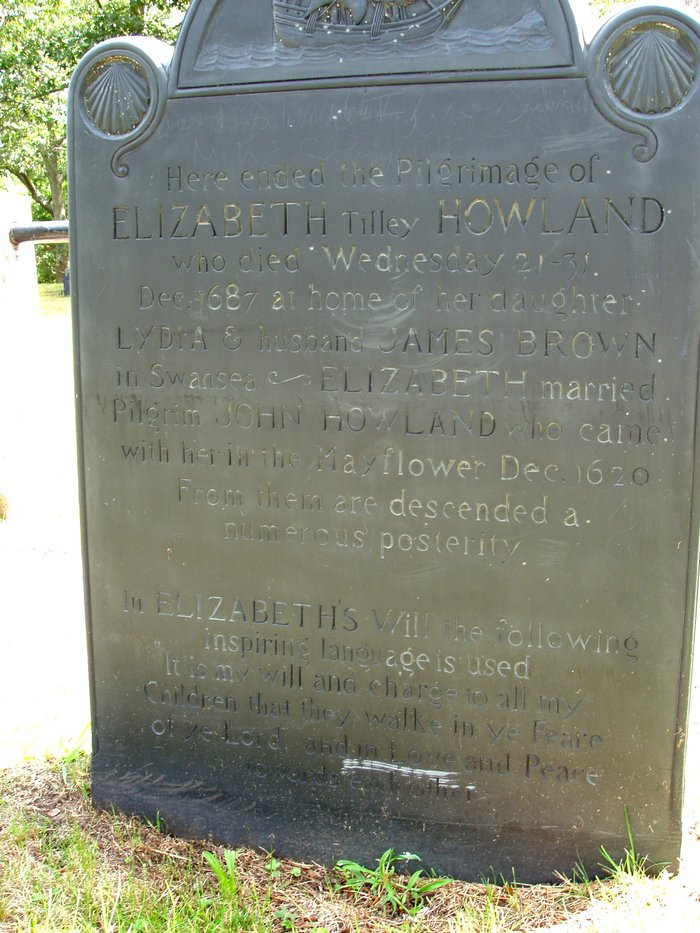
I couldn’t believe it.
Come to find out Swansea wasn't just where I thought it was today. Back then, "Swansea" extended all the way to the Riverside section of East Providence.
Over four hundred years—and roughly fifteen generations—later, Erin had been living within walking distance of the final resting place of her 11th great grandmother… one of only about fifty Mayflower passengers who survived that first brutal winter.
As with most of these moments of enlightenment I come across, this one, again, came at 3:00 in the morning.
Which meant, of course, that Erin—who had to be up in two hours—was startled awake by me shrieking:
“Holy shit! You're not going to believe this!"
Would you believe me if I told you that she was, again, unimpressed?
I'll let this one slide... but only until I tell her again when she is fully awake.
Final Thoughts
I thank Ancestry.com—despite its costly subscription price—for the service it provides.
There are so many events included in every click of a name. The lines connecting the names of the family branches are not there, simply, as visual aids. They tell stories.
Instead of reading between the lines, we need to read inside the lines.
It is an exercise in self discovery. You will find yourself asking questions like:
Am I a teacher today because that is what I chose to do? Or is teaching in my blood once I learn that I come from a family of teachers? Maybe I had no choice—teaching chose me, not the other way around.
Why do I love writing or drawing? Why do I feel like it comes so naturally? Are there any authors, poets, and artists in my lineage?
I bet you would find a lot of explanations for why you are the way you are.
One last anecdote:
I, recently, joked with Erin's family when her brother was recounting a story about how rebellious he was as a child.
My response was:
"You couldn't help it. You have the Sons of the Revolution blood flowing in you."