America Is Mad as Hell — But Doesn’t Know What to Do About It

Bob Barker would be so proud. The legendary longtime host of the TV game show The Price Is Right ended every show by reminding viewers to "have your pets spayed or neutered."
Well, Bob, I don't know about pets, but I'll tell you one thing—the American public sure has become neutered.
That's right. I said it.
I feel like Peter Finch in the 1976 classic Network. Finch plays Howard Beale, a prominent nightly news anchor from the era when most Americans still got their evening news from one of three major networks. After he is fired, Beale is allowed to give one final farewell to his audience. What follows is one of the most iconic rants in cinematic history.
Disheveled and unhinged, Beale hunches over his anchor desk and stares straight into the camera. He rants about a public that has grown numb to everything around it — crime, inflation, environmental pollution, political corruption, and the steady collapse of basic decency.
Sound familiar?
Then Beale rises from his chair and commands his viewers to do the same. He tells them to open their windows and scream into the night: “I’m as mad as hell, and I’m not going to take this anymore!”
The camera cuts to people across the city doing exactly that — throwing open their windows, leaning into the darkness, and shouting his words back at a world that had made them feel powerless for too long.
As we approach the 250th anniversary of the birth of our country, Howard Beale would be beyond mad as hell—whatever that may be.
Because America was not born from complacency or blind subordination. The United States was born — and has continued to grow — when patriotic Americans were called to action by political, social, and moral injustice.
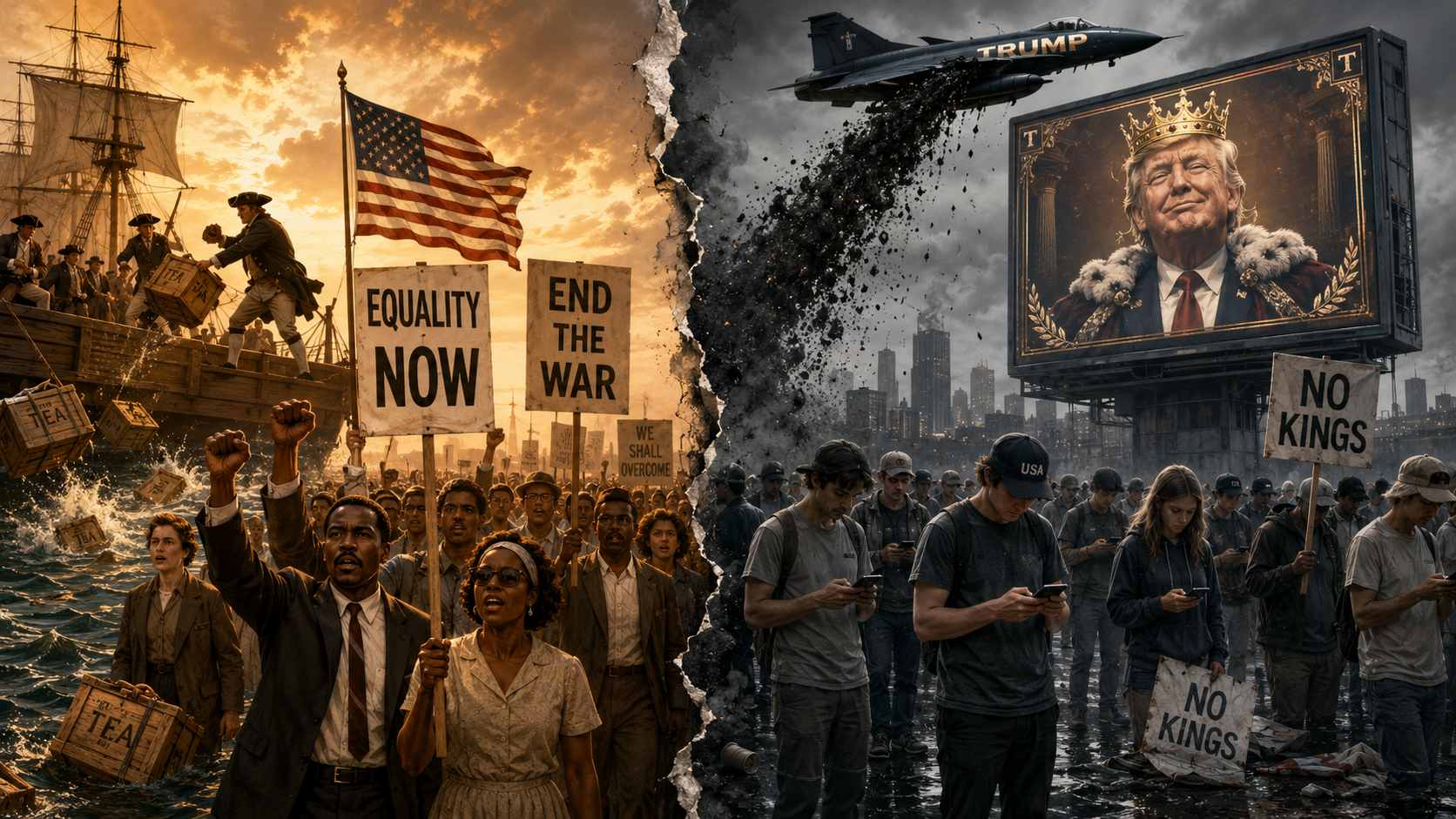
The first example that comes to mind happened barely an hour from where I live. In 1773, American colonists boarded British ships in Boston Harbor and dumped tea into the water — tea worth roughly $3 million in today’s dollars. It was a direct protest against England’s claim that it could tax the colonists without giving them any voice or representation in the government imposing those taxes.
Those Sons of Liberty were sending a message meant to get the attention of the King of England. They hit the Crown where it hurt — the wallet, or the coin purse, or whatever they used back then. There was no way for the British to ignore it, or to just laugh it off as those "silly American colonists."
In the 1800s, you might think I am going to mention the Civil War as another example. But, not really. The Civil War was the culmination of a movement—decades of abolitionists refusing to accept slavery as a permanent reality. Abolitionists understood that slavery was not just politically polarizing, but morally wrong.
They brought attention to the issue by being vocal, organizing, writing, publishing, petitioning—whatever it took—and forcing the country and its leaders to confront an evil it often preferred to just sweep under the rug.
Some abolitionists took even greater risks by participating in the Underground Railroad—a secret passageway that helped enslaved people escape from the South toward freedom in the North and Canada. Those who helped the fleeing slaves risked arrest, expensive fines, violence, and in some cases death. That took courage.
The 1960s brought perhaps the most sustained period of civil unrest in modern American history. Civil rights marches, Freedom Rides, marches on Washington D.C., antiwar demonstrations, deadly student protests, urban riots, and, tragically, political assassinations represented the rebellious spirit of an entire generation of Americans born after World War II.
Malcolm X and Martin Luther King Jr. approached the struggle for civil rights with polar opposite approaches. Malcolm X fired up his followers with sharp, angry rhetoric. He was tired of the idea that Black Americans should patiently wait for justice. They had already waited too long. He preached to his followers to defend themselves—even if that included violence. "Sit-ins" was not his style of protest. He chose to fight fire with fire.
King believed in doing the opposite of Malcolm X. He embraced the nonviolent, disciplined protest, and diplomatic approach—all things Malcolm X scoffed at.
King’s vision was captured most famously in his “I Have a Dream” speech, delivered from the steps of the Lincoln Memorial before hundreds of thousands of people gathered for the March on Washington in 1963.
The Reflecting Pool served as a backdrop for the MLK speech—long before the $14 million renovation that Trump, recently, ordered which has failed to kill the algae floating in it.
While Malcolm X and Martin Luther King Jr.'s approaches were starkly different, they were trying to achieve the same goal.
Ted Kennedy used the following words to eulogize his slain brother, Robert, in 1968, but they could just as easily apply to Martin Luther King Jr., Malcolm X, Robert Kennedy, and to an entire generation who refused to do things just because that is how it has always been done:
“My brother need not be idealized, or enlarged in death beyond what he was in life; to be remembered simply as a good and decent man, who saw wrong and tried to right it, saw suffering and tried to heal it, saw war and tried to stop it.”
It could be argued the civil unrest of the 1960s and early 1970s helped take down two presidents.
I have always believed Lyndon Johnson was one of the greatest legislative presidents in American history. Under Johnson, the country passed the Civil Rights Act of 1964, the Voting Rights Act of 1965, Medicare and Medicaid, the Elementary and Secondary Education Act, and the Immigration and Nationality Act of 1965 — the very law that allowed my parents to come to America in 1967.
Terrific speech by Lyndon Johnson announcing the signing of the Civil Rights Act of 1964. My favorite quote is, "Those who founded our country knew that freedom would be secure only if each generation fought to renew and enlarge its meaning."
Without LBJ and that Immigration Act, I might be living in a small remote village on a hill in Portugal right now instead of writing this from the comforts of my air-conditioned living room in southern New England.
However, Johnson's downfall was the Vietnam War—a war he had, admittedly, inherited from his predecessors, but which he did escalate.
Unlike the complacency we see today in the face of unlawful military actions in Venezuela and Iran, Americans in the late 1960s and early 1970s took to the streets and kept the pressure on the federal government to end the Vietnam War and bring American troops home, safely.
The political pressure got so great that Johnson shocked the nation in 1968 by announcing he wasn't going to run for re-election in order to focus all his efforts on the struggle in Vietnam. For a man as politically driven and motivated as Johnson always was, I cannot even imagine how hard that must have been for him to concede a second term as president.
In fact, LBJ would die almost exactly four years after leaving office.
Johnson's successor, Richard Nixon, was ultimately forced to resign due to the Watergate scandal, but he, also, fell victim to the public uproar regarding the war. When Nixon expanded the Vietnam conflict into Cambodia, protests intensified across the country.
In 1970—in an incident eerily reminiscent of the murders of Renee Good and Alex Pretti by federal ICE agents—a protest at Kent State turned deadly when National Guard troops opened fire on student demonstrators, killing four.
Crosby, Stills, Nash, and Young famously wrote a song about the tragedy called, "Four Dead in Ohio."
Four months prior to the Kent State tragedy, Nixon was caught calling college student protestors "bums" while speaking, informally, to employees from the Pentagon:
You see these bums, you know, blowing up the campuses. Listen, the boys that are on the college campuses today are the luckiest people in the world... Then out there [in Vietnam] we have kids who are just doing their duty.
The spirit of protest carried into the 1980s and 1990s as well.
The anti-apartheid movement pressured governments, universities, and corporations to stop supporting South Africa’s racist regime. The ultimate victory came in 1990 when Nelson Mandela was released from jail after being wrongfully imprisoned for 27 years. He went on to become President of South Africa in 1994 when he won the country's first fully democratic election.
In 1989, there was a man who stood, defiantly, before a rolling line of tanks in Tiananmen Square. It is an image seared into my memory for the man's bravery and courage.
It is one of the most amazing historical images ever photographed, in my opinion. I hate to wonder whatever happened to that person after the world turned its attention to other things. There is no record of who he was or whatever happened to him.
The last historical example I will mention showing the effect of courageous rebellion is, probably, the granddaddy of them all since the end of World War II—the fall of the Berlin Wall.
The heavily-graffitied Berlin Wall — which divided Western-controlled West Berlin from Soviet-controlled East Berlin — had stood for nearly three decades as the most iconic symbol of the divide between the democratic West and the communist East.
The Wall did not fall because the proud people of Berlin quietly accepted life on one side of the wall one way, and life on the other side an entirely different, and better, way. From the time The Wall was built in 1961, entire families risked their lives trying to escape Communist East Berlin to flee to West Berlin or other nations altogether.
By November 1989, the pressure from the citizens of East Berlin had become too great. Enormous crowds gathered, surged forward, and were met with no resistance from the Communist guards on duty. The Berliners then began tearing down The Wall as people cheered while watching on their televisions all across the world.
Shakespeare wrote in The Tempest that “what’s past is prologue.” If we are to learn from history, it is that people in power rarely change their minds because they suddenly discover a conscience.
Change only happens when the suppressed stand up for themselves and decide to stop allowing themselves to get walked upon—or shit on, as I will explain soon.
Which brings us to today.
Americans today appear to be outraged ("Mad as hell") by the actions of Donald J. Trump, and they have plenty to be outraged about: blatant corruption, evidence of insider trading, his cozy relationships with authoritarian leaders, the weaponization of investigative and justice agencies against political foes, attacks on freedom of speech, the demolition of the East Wing of the White House without proper authorization, the appointment of grossly underqualified cronies to positions of power, unauthorized military conflicts... and what's hidden in the Epstein Files.
There is no shortage of other scandals, abuses, and violations of basic presidential norms — any one of which would have been enough to destroy the presidency of nearly any of the 44 men who held the office before him.
Even George Washington and Honest Abe would not have survived this much scandalous activity. They would never have dreamed of doing any of them!
And what has the American response been, beyond posting complaints online, venting on cable news, or shaking our heads at the latest outrage? Well, they may pretend to be "mad as hell" on social media, but they sure are willing to just sit in front of their computers, or on their phones, and "take it."
I suppose you can point to the sporadic No Kings protests, which seem to be held less often than the times I get my car's oil changed.
But honestly, what is the point of them? Once every few months, people gather in cities across the country. They hold their signs. They honk their cars... beep, beep! They talk into their bullhorns. They make speeches. They wear the personalized T-shirts and hats.
Then what?
They go home, put the shirts and hats back in a drawer until the next scheduled day of outrage, and turn on the TV to see if they can see themselves on the news. Then they go back to work the next day feeling like they did something.
Today’s society, among many other things, seems to have forgotten how to protest to get results. Like most everything else nowadays, Americans half-ass their protests. They do it for show. It is style over substance. It's like taking a punch from Pee Wee Herman.
In the 1960s and early 1970s, public unrest helped bring down the Johnson and Nixon presidencies.
Today, Trump seems amused by all of it. His reaction to the No Kings protests was not fear, humility, or self-reflection.
Just the opposite.
His immediate reaction was to post an AI-generated video of himself flying a fighter jet and dumping gooey, brown shit from the jet's payload onto the protesters below.
So presidential. Could you picture Kennedy or FDR doing that if they had the technology back then? Little did I know then that Trump's fascination with AI-generated images would get even more disgusting.
But again, I ask—what do the No Kings protests accomplish?
Just this week, Trump appeared at Madison Square Garden for Game 3 of the NBA Finals. When he was shown on the big screen during the national anthem, the crowd loudly booed him.
His reaction?
A little smirk.
He even had the gall to claim afterward that he heard more cheers than boos.
Like so much else that comes out of his mouth, it was an utter lie. But what does he care? He lies more times in a day than I do in a year, and still the country shrugs it collective shoulders.
The apathy is absolutely appalling.
The Epstein files are another example. Trump promised transparency, yet he has only released half the files—despite Congressional "orders"—and the files that were released have been clouded by redactions.
The New York Times, just a couple of days ago, published a story revealing Vice President J.D. Vance has been holding meetings in the White House Situation Room in regards to how to handle the remaining 3 million unreleased pages of the Epstein files.
The Situation Room is traditionally used for high-stakes military and national security operations—think 9/11, Cuban Missile Crisis, the aforementioned Vietnam War.
How are mobs of people not stationed every single day outside the White House demanding release of the remaining files?
Ignoring the politics — and that is not easy to do — this past decade has been a clinician’s dream for anyone studying the sociological and psychological changes in modern American society.
How did we become like this?
How did a country that once produced the Boston Tea Party, the Underground Railroad, “I Have a Dream,” Kent State, and anti-apartheid activism get to the point where a sitting United States president can symbolically dump shit on his own citizens and the country simply shrugs it off and says, "That's Trump for ya"?
Or how about when he posts AI-generated images depicting the first Black president and First Lady as monkeys? He didn't even have the decency to say he didn't do it.
He didn't have to. The country let him get away with it.
How about when he attacks... the Pope? And then he responds by posting an AI-generated image of him as Jesus healing the sick! He claimed he thought he looked like a doctor.
He can say whatever he wants. He knows nobody is going to hound him about it. If someone does, Trump just avoids answering any further questions by insulting reporters by saying, "You're a dumb reporter. You should be ashamed of yourself. And your network is awful, too. You're a disgrace."
When is a reporter going to have the "balls" to say to him, "Sir, you are a disgrace. You are a dumb president. You should be ashamed."
My money is on Kaitlan Collins.
These actions by a president are not normal. They are acts of contempt to his constituents. Call it what it is—DISRESPECT.
And yet, we shrug our shoulders and laugh about Trump's antics on late-night comedy shows.
I like Jimmy Kimmel and I usually check his monologues out the next day on YouTube, as well as Jon Stewart's. That's how I choose to consume my news... with a spoonful of sugar.
But it bothers me when an audience laughs at things like Trump cutting off the Queen of England in a receiving line or appearing to fall asleep during Cabinet meetings.
We have turned serious breaches of dignity, congeniality, and basic presidential decorum into late-night punchlines when, instead, we should be "mad as hell, and not taking it anymore."
We, as a society, know how to express disgust and anger, but we do not know how to do anything about it. We know how to see corruption, but we just point our fingers and wag them like, "Hey, you."
We find ourselves saying at least once every day, “This is unacceptable,” yet we allow it to happen over and over again.
American colonists at the Boston Tea Party knew how to hit England where it hurt. The civil rights movement had the passion, intellect, discipline, and intestinal fortitude ("guts," "balls," "cojones") to be unrelenting in applying pressure on our leaders every single waking moment—which, in Trump's case, shouldn't be too hard.
Today’s society does not know how to bring about change.
Obviously, I am not talking assassinations like back in the 1960s or the "attempted" ones on Trump.
This November presents the best opportunity to fight back. If the Democrats win back control of Congress, maybe Congress will assume their rightful place as an equal part of the checks and balances of our government which were installed in the Constitution.
The other things people could do is assemble on a daily basis outside the White House with their bullhorns and signs.
Stop staying at Trump-owned properties. Stop buying Trump-branded products. Boycott anything attached to his name the way a vegan avoids meat.
The thing that gets Trump out of bed at 11 o’clock in the morning — after a full night of posting on social media — is attention. So stop giving it to him. Stop treating every insult, every lie, every tantrum, and every childish AI-generated image as front page news.
Trump feeds on reaction. He views the presidency as a reality show—hence all the public Cabinet meetings and the photo-op White House meetings with foreign dignitaries.
It is time for Americans to get off their couches, put down their phones, go to their windows and scream, "I'm mad as hell and I'm not going to take it anymore!"
And then do something about it.
(Don't go back and sit down and get back on your phone!)