
The Invisible Cost of Caregiving

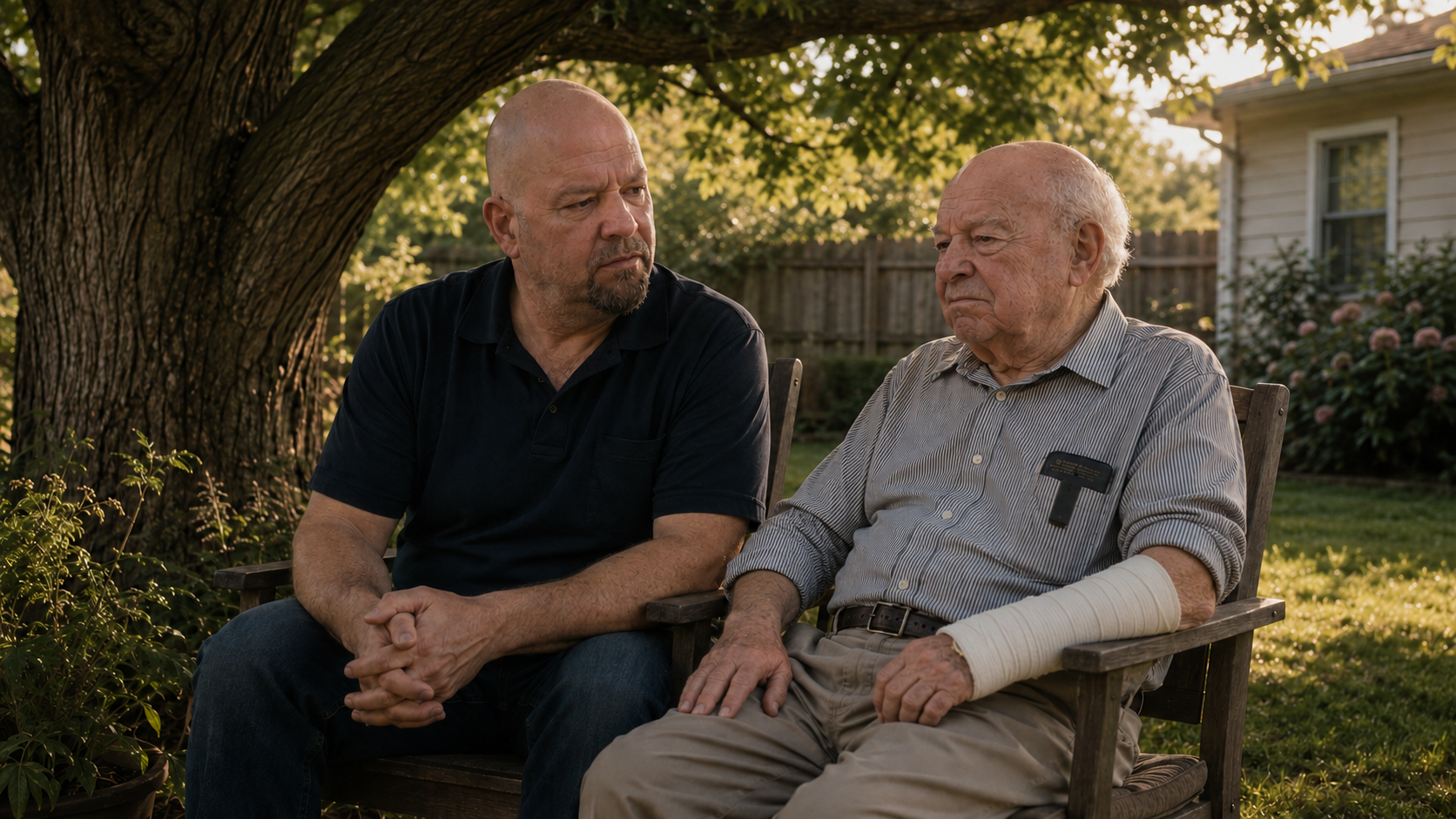
Three weeks ago, my 91-year-old father fell on a cement walkway in our yard while moving some lawn chairs. The result was a broken right wrist. He is right-handed. Of course.
At first, doctors put his right wrist and forearm in a cast. Two weeks later, they decided he needed surgery.
The rationale was that they didn't realize my dad was as active as he was for a man his age. Had he been bedridden or living in a nursing home, they probably would have allowed the wrist to heal the best it could. He might have been left with limited flexibility and some permanent pain, but surgery would not have been worth the risk.
For the first 24 hours after surgery, I had to keep reassuring him that his arm had not been permanently damaged. He was absolutely freaking out. He could not feel his right arm. It was “just dangling there, like a stump of flesh,” in his words.
I explained that the numbness was caused by the nerve block used during surgery. General anesthesia had been ruled an unnecessary risk at his age. The doctors had told us that the numbness might last into the next day.
But there was no reasoning with him. The doctors botched the surgery, he insisted—and it was my fault they did (that was the insinuation, anyway).
A broken wrist may not sound catastrophic, but for someone his age it is. And for me as a caregiver, it absolutely is.
He now needs help getting dressed. Naturally, he insists on wearing button-up, long-sleeved shirts and regular pants with a belt. T-shirts, sweatpants and shorts have never been acceptable clothing options to him.
That would be too easy for me.
He needs help preparing meals. I never realized how many potatoes the man ate until he broke his wrist. I have been peeling three or four potatoes for him nearly every day. He has never been much for restaurant food or takeout. Definitely not pizza.
Again, too easy for me.
Another unexpected thing I had to stay on top of was making sure I loosened all the caps on his drinks in the fridge. Ever try opening a bottled water one-handed? I tried to show my dad how it could be done. It didn't end well. Water squirted everywhere.
Then there is the yard and his garden.
My father moved to the United States from Portugal in 1967. He does not speak English. He grew up working in the fields, and I have always believed that his garden is his way of recreating a small piece of his homeland in our backyard.
He grows beans, cucumbers, lettuce, cabbage, tomatoes and onions. There are also apple, peach and pear trees scattered throughout the property.
It gives him that "old country" feel. It also keeps him busy. That is good for him.
Let me rephrase that, it is good for him when he is healthy. For me, however, it is another nuisance to add to my list.
But welcome to caregiving. What was their life now becomes your life.
The Weight Caregivers Carry
The medical field has a term for all the physical, emotional, social and financial strain of caring for another person. It is called caregiver burden. If left unmanaged, caregiver burden leads to caregiver burnout. I was expecting some fancier terms—something with a lot of consonants and not many vowels—but there you have it.
The challenge with caregiving is that it is not a nine-to-five job (if those even exist anymore). Caregiving is a 24/7 cloud that hangs over your head at all times.
Caregivers are constantly on edge waiting for the next crisis to happen. And I use the word "crisis" loosely.
My father has called me just to tell me someone telephoned the house and he did not know who it was. But it sounded important. He has called me at seven in the morning because his television remote was not working.
Yet he constantly lectures me about not answering the phone sometimes when he calls.
"I'm screwed if I ever need you in an emergency."
I have to keep reminding him of the American fable of the boy that cried wolf. He doesn't get it—not surprisingly.
Research has shown that prolonged caregiving results in depression, anxiety, fatigue, problems sleeping, and overall worsening physical health.
Check, check, check, check, and check.
The demands placed on caregivers are still not discussed nearly enough.
I witnessed that lack of understanding while pursuing disability benefits for major depressive disorder. When my claim was denied, the decision made no mention of my mother’s death or the years I spent attempting to balance her care with a demanding career, my relationships, and my own deteriorating mental health.
I'd be willing to bet—well, wait a minute, I don't have anything to bet with—that this judge has never had to care for a dying loved one.
My Aunt's Passing
Last month my 93-year-old aunt passed away. She was the last of my father's three siblings.
She also suffered from dementia and had been cared for primarily by one of her daughters and her daughter’s husband. I will call him Charles. Charles is an absolute saint in my book.
He was also heavily involved in caring for his father-in-law before he died. I remember being touched by the way Charles remained at his bedside. He was not a blood relative, but he cared for the man as if he were his own father.
Since my mother died, Charles has also been an important part of my father’s life. Every Saturday afternoon, he comes over and takes him to church. I certainly wasn't going to do that.
What Charles has done is noble. It has also taken a devastating toll on him. An outsider might not notice it, but I do. I recognize the hunched shoulders, the blank stare and the silence.
Charles was once one of the most sociable and fun-loving people I knew. He had a loud, unmistakable laugh that could fill a room.
Now, on the rare occasions when I get him to laugh, it is often a short, obligatory “ha.” It is as though he recognizes that a moment is supposed to be funny, so he gives it the smallest laugh he can manage.
To make matters worse, he did lose his own father a year ago. Charles is an only son so he had the burden of dealing with funeral arrangements all by himself. His father also owned a couple of apartment buildings so now those—and the however many tenants that lived in them—belonged to Charles.
Like me, Charles seems to absorb the suffering of the people around him. To me, Charles has aged 20 years over the past four or five.
Sadly, I am sure it is going to wind up taking years off his life.
Watching My Mother Disappear
I first assumed the role of caregiver around 2016, when I began noticing changes in my mother. That was years before I heard the words Lewy body dementia.
Her doctor’s appointments went from once every six months to seemingly once every two weeks as medical professionals struggled to determine what was happening. I knew it was some form of dementia way before the doctors did. No one, including my father, knew my mother better than I did.
Her mental deterioration led to more frequent falls. On one occasion, she broke her hip while playfully chasing our cat through the backyard. She also broke her right wrist twice.
While dealing with her accidents and living in constant fear of the next one, I was also running a busy fast-food restaurant and regularly working 50 to 60 hours a week.
I would spend my workdays dealing with employee problems, equipment malfunctions, handling angry customers and answering to demanding supervisors. Then I would come home to an increasingly depressing atmosphere and attempt to fix problems that I refused to admit had no solutions.
Growing up, I always told myself that I would never put my mother in a nursing home. I believed I would have no problem bathing her, feeding her or wiping her ass when the time came.
I was naive.
I had never considered the possibility of dementia. I had never imagined being afraid to fall asleep because my mother might wake up in the middle of the night and walk down the street wearing nothing but her nightgown.
Eventually, the responsibility of finding a nursing home fell on me. My father wanted no part in making the decision. He told me to do what was best for her. My mother deserved the best care, he said. Money did not matter.
Until it did.
The first facility I found specialized in Alzheimer’s and dementia care. It was the perfect place for her. That lasted only a few months before my father began complaining that it cost too much—approximately $8,000 per month.
We moved her through several facilities before settling on the one where she eventually died. Each time, relatives would tell me that my father was criticizing the choices I made.
He did not want the responsibility of making any of the decisions. But he didn't hesitate to judge my decisions after the fact.
My mother first entered nursing-home care in late 2019.
Then COVID arrived.
In March 2020, nursing homes shut their doors to visitors. During the final year of my mother’s life, I was allowed to see her only three times. Each visit lasted approximately 15 minutes.
Dementia was already taking away her ability to recognize me. Then the pandemic took away my ability to be with her, touch her hand or reassure her that I had not abandoned her. That was, and is, my biggest and only feeling of guilt about her passing.
I still wonder what she thought. Did she understand that there was a virus? Did she know why I had stopped visiting? Or did she believe that the son who promised never to leave her had simply disappeared?
When the Next Parent Needs You
After my mother died on the last day of March 2021, I tried to carry on. I continued working through the grief, depression, burnout and lingering chaos of the pandemic. Eventually, I could not do it anymore. I stopped working in October 2021. I thought I needed a couple of weeks to recover.
I haven't been back to work since.
For the first several months after my mother’s death, my father seemed to be doing surprisingly well. Better than well, actually. It bothered me how well he seemed to be doing while I was struggling just to get out of bed in the morning.
Starting around early 2023, however, I began noticing a gradual deterioration in both his physical and mental abilities.
That summer, he was involved in a minor car accident. That ended his driving days. From that point forward, I became responsible for taking him shopping, driving him to medical appointments and bringing him to see friends and relatives.
The responsibilities began adding up as he got more comfortable with the arrangement.
First, it was transportation. Then he asked me to organize his weekly pillbox. A month later, he asked me to begin handling his bills.
During the past year, he has been hospitalized three times. Last September, he spent three weeks in the hospital. For the first several days, we did not know whether he was going to survive.
The sad part is… I kind of enjoyed those days when he was in the hospital.
Not because I wanted him sick.
I just enjoyed the temporary relief of knowing that someone else was responsible for him.
Visiting Is Not Caregiving
I have one older brother who is 11 years older than me. He and my father are alike in ways that my father and I have never been. I am far more like my mother.
My brother generally visits once a week, usually on Sundays, for somewhere between 15 and 30 minutes. Since my father broke his wrist—and with the World Cup soccer thing going on—he has been coming around more frequently to watch soccer with him.
Being Portuguese, they have their love of soccer in common, among many other things. I just never received the "soccer" chromosome.
But I am glad they have that connection.
I appreciate, and enjoy, the time my brother spends with my dad. It again gives me a few hours where I can breathe easy.
But watching a soccer game with someone is not the same as caregiving. He spends a couple of hours with him. Then he leaves. I am left with still dealing with the medications, bills, appointments, meals, clothes, transportation, bottles, garden and potatoes after the game ends.
Caring for Someone Who Never Says Thank You
The greatest challenge in caring for my father is that he is not appreciative. Never has been. Never will.
“Thank you” and “I love you” do not seem to be part of his vocabulary.
My mother was selfless. My father has always expected his wife, sons and relatives to serve him.
As a child, I never measured up to his lofty expectations. As an adult, he has told me that I was the cutest baby anyone had ever seen. He has told me I was the smartest child in school.
Nice, right?
However, those comments are always followed with the question, "What happened to you?"
Those experiences do not disappear simply because he is now elderly and needs me.
I help my father now because I don't like seeing anyone suffer. I help because someone has to. I help because, despite everything, he is my father.
But caregiving does not fix a relationship. The issues are always right under the surface just waiting to rare its ugly head.
Recently, we have been arguing more because he believes I do not spend enough time with him.
One day, in front of my brother, my father told me I had an obligation to inform him every time I left the house.
“Oh, like punching a clock?” I asked.
For younger readers, people once had to insert a paper card into a machine that stamped the time they arrived at and left work.
Apparently, I am now required to do the same before leaving my own home. Now that I think about it, that sounds like an appropriate analogy.
The Fundamentals of Caring
About a month ago, I randomly watched a 2016 movie called The Fundamentals of Caring, starring Paul Rudd.
Rudd plays a man dealing with his own personal tragedy who becomes a professional caregiver.
At the beginning of the movie, he attends a caregiving class. The instructor emphasizes the importance of boundaries. Do what you have to, but don't feel obligated to do too much more.
I think the exact words were to "give care, but not care too much."
You don't have to sit with the patient in his room watching TV for an hour. You don't have to sit there and play checkers with them.
Your responsibility is to make sure their necessities are met—they are fed, bathed, clothed, given medication, and safe. Anything beyond that is going above and beyond.
The scene spoke to me. It affirmed my belief that if I check in on my dad two or three times, very briefly, that I am fulfilling my responsibility. I don't need to sit in the yard with him for an hour. I don't have to watch a World Cup soccer game with him. I just need to make sure he is fed and, basically, that he is alive and comfortable.
When I explained that scene to my brother and told him it made me feel better, he responded:
“Yeah, but that applies to taking care of strangers. This is our dad.”
Damn him!
My brother is right. This is our dad—emphasis on "our." But being his son does not mean surrendering my life and putting my life on hold until the inevitable happens.
I can make sure he is safe, fed and cared for without also becoming his entertainment, constant companion, and—quite frankly—his servant. I don't need to go above and beyond what I believe to be necessary—not what he feels is necessary.
Caregiving may be an obligation, but it does not erase the past or heal every wound between a parent and child.
Outsiders see the "cute, poor old man"—I get that every time I take him to an appointment— but no one notices the "poor caregiver" who is sacrificing their time, energy, and freedom that is working behind the scenes.
When the person you care for is gone—and, trust me, I take nothing for granted; I may be the one who goes first—the caregiver is left to pick up the pieces of a life that may have been on hold for years.
There will come a time when the caregiver has to find a way to reclaim parts of themselves they lost and learn how to live for themselves again. But sometimes the things that were lost are gone forever.